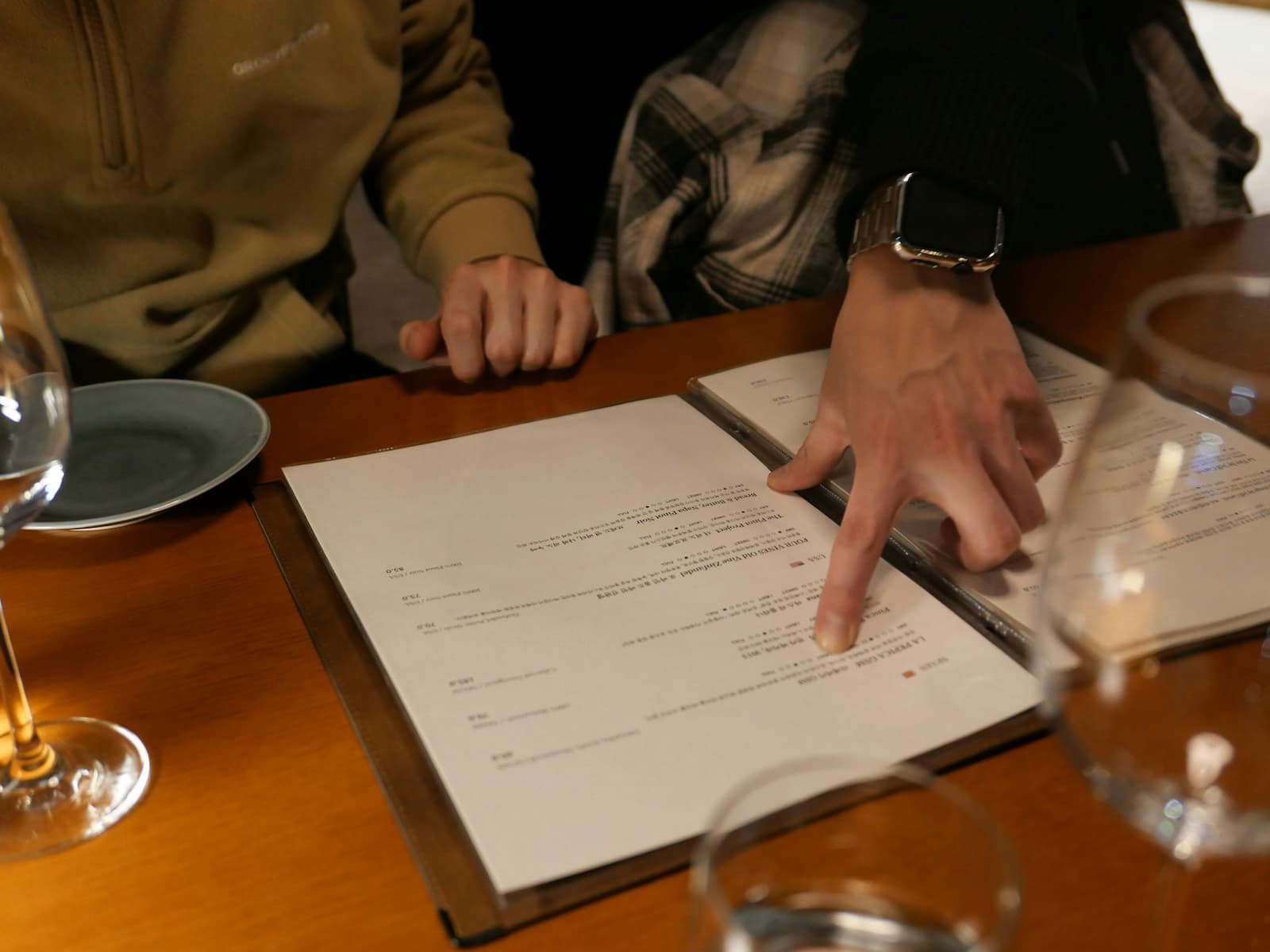
Menu pricing is not only about the price of each individual item.
It is also about the distance between prices.
Customers rarely look at one menu item in isolation. They compare. They scan a section. They notice which items are cheap, which feel standard, which feel premium, and which prices seem difficult to justify.
That is why menu price gaps matter.
A $16 dish may feel fair in one section and expensive in another. A $24 item may feel premium if the price ladder supports it, or risky if the jump from nearby items is too large. A menu where everything is priced almost the same may look simple, but it can make customer decisions less clear.
Good menu pricing needs structure.
That structure is often called price architecture.
Quick answer
Menu price gaps are the differences between prices inside a menu section or across similar items.
Clear price gaps help customers understand the menu. They show which items are entry-level, standard, premium, or special. But when prices are too close together, customers may not understand the difference between items. When prices are too far apart, higher-priced items may feel risky or overpriced.
A strong menu usually needs a clear price ladder.
That means customers can understand why one item costs less, why another costs more, and what extra value they receive when they trade up.
What are menu price gaps?
A menu price gap is the distance between one menu price and another.
For example:
- Classic Burger — $13
- Cheeseburger — $14
- House Burger — $16
- Premium Beef Burger — $24
The gaps are:
- $1 between Classic Burger and Cheeseburger,
- $2 between Cheeseburger and House Burger,
- $8 between House Burger and Premium Beef Burger.
The first gaps are small. The last gap is large.
That does not automatically mean the pricing is wrong. But it does mean the menu needs to explain why the premium burger costs much more.
If the premium burger includes aged beef, special cheese, house sauce, fries, and a larger portion, the price may work. If the description is weak, the $24 price may feel exposed.
Price gaps are not only numbers.
They are signals.
They tell customers how to understand the menu.
What is a menu price ladder?
A menu price ladder is the visible progression of prices inside a category.
It helps customers move from basic options to more premium choices.
For example:
- Small Coffee — $3.00
- Latte — $4.50
- Specialty Latte — $5.50
- Seasonal Signature Drink — $6.50
This ladder is easy to understand.
Each step feels logical. The customer can see a progression from basic to more complete or more special.
A weak price ladder may look like this:
- Small Coffee — $3.00
- Latte — $5.90
- Specialty Latte — $6.10
- Seasonal Signature Drink — $6.20
Here, the jump from coffee to latte is large, but the premium options are almost the same price. That can confuse the customer.
The question becomes:
“Why is the latte so much more than coffee, but the signature drink only slightly more than the latte?”
A good price ladder helps customers understand value.
A weak price ladder creates hesitation.
What is price architecture?
Price architecture is the overall structure of prices across the menu.
It includes:
- price gaps,
- price ladders,
- entry-level options,
- mid-range options,
- premium options,
- add-ons,
- upgrades,
- bundles,
- and price anchors.
Good price architecture helps customers understand the menu faster.
It answers questions like:
- What is the basic option?
- What is the better option?
- What is the premium option?
- What is the best value?
- What is special?
- Why does this item cost more?
When price architecture is unclear, customers may default to the safest or cheapest option.
That can hurt item performance, average spend, and margin.
Why prices that are too close can be a problem
Many restaurants try to keep prices close together because it feels simple.
For example:
- Chicken Sandwich — $12.50
- Pulled Pork Sandwich — $13.00
- Beef Sandwich — $13.50
- Vegetarian Sandwich — $13.00
This section looks tidy. But it may not help the customer understand the difference between items.
If all prices are almost the same, customers may ask:
- Which one is premium?
- Which one is best value?
- Why does one cost slightly more?
- Is the difference meaningful?
- Should I just choose the safest option?
When prices are too compressed, the menu can feel flat.
A flat section gives the customer little guidance. They may choose based on habit, familiarity, or the cheapest recognizable item.
That may be fine if all items have similar margins and similar roles. But if one item is more profitable, more strategic, or more premium, compressed pricing can hide that difference.
Price compression can weaken premium items
Price compression happens when prices are too close together.
This can be especially harmful for premium items.
Example:
- Classic Pasta — $15
- Mushroom Pasta — $16
- Seafood Pasta — $17
- Handmade Truffle Pasta — $18
At first, this looks customer-friendly. Nothing feels too expensive.
But the premium item may not feel premium.
If handmade truffle pasta is only $1 more than seafood pasta, customers may not understand the pricing logic. They may wonder whether the truffle pasta is really special, or whether the other pastas are overpriced.
A premium item needs enough distance to feel different.
If the gap is too small, the item may lose its role as a premium option.
The menu may also miss an opportunity to increase average spend from customers who would have accepted a higher price for a clearly special item.
Prices that are too far apart can create hesitation
Large price gaps can also create problems.
Example:
- Classic Burger — $13
- Cheeseburger — $14
- House Burger — $15
- Premium Beef Burger — $25
The jump from $15 to $25 is big.
That does not automatically mean the premium burger is wrong. But the menu needs to support the jump.
If the premium burger has a weak description, customers may think:
“Why is this so much more expensive?”
Large gaps need strong value signals.
Those signals can include:
- better ingredients,
- larger portion,
- special preparation,
- sides included,
- house-made components,
- limited availability,
- premium sourcing,
- or a clear signature role.
Without those signals, large gaps can make premium items feel risky.
Customers may avoid the item, even if it is profitable and high quality.
The cheapest item can become too powerful
Price gaps also affect how customers respond to the cheapest item in a section.
For example:
- Basic Pasta — $11
- House Pasta — $15
- Seafood Pasta — $22
If the basic pasta feels familiar, safe, and visible, many customers may choose it. That can be a problem if the item has weak margin or pulls attention away from better options.
The cheapest item becomes an anchor.
It sets the customer’s expectation for the rest of the section.
If the gap between the cheapest item and the middle item feels large, customers may trade down.
The question is not:
“Do we have an affordable option?”
Affordable options can be important.
The better question is:
“Is the cheapest item helping the menu, or controlling the menu?”
A strong menu can offer accessible choices without letting the cheapest item dominate customer decisions.
The middle option often needs the most support
Many customers avoid the cheapest and most expensive options. They look for the safe middle.
That makes the middle of the price ladder very important.
For example:
- Basic Burger — $12
- House Burger — $16
- Premium Burger — $23
The house burger may be the item you want customers to choose most often.
But it needs to feel like the best value.
If the description is weak, customers may drop to the basic burger. If the premium burger is poorly supported, customers may avoid it and still choose the basic burger. If the gap between basic and house feels too large, the house burger may feel expensive.
The middle option should usually be clear, attractive, and easy to justify.
It can be supported with:
- stronger wording,
- better placement,
- “house” or “signature” framing,
- included sides,
- clearer ingredients,
- or a visible reason to trade up.
A well-supported middle option can improve both customer confidence and menu performance.
Price gaps affect perceived value
Perceived value is what the customer believes they are getting for the price.
Price gaps shape perceived value because customers compare options.
Example:
- Margherita Pizza — $12
- Pepperoni Pizza — $14
- Prosciutto Pizza — $18
- Truffle Pizza — $28
The $28 truffle pizza needs to feel very different from the $18 prosciutto pizza. Otherwise the customer may see the gap as unfair.
Now compare:
- Margherita Pizza — $12
- Pepperoni Pizza — $15
- Prosciutto Pizza — $19
- Truffle Pizza — $25
This ladder may feel smoother. Each step gives the customer a clearer sense of progression.
The right price gap depends on the category, the business, the item, and the customer expectation.
There is no universal perfect distance.
But there should be logic.
Customers should be able to understand why one item costs more than another.
Price gaps affect item performance
A menu item can perform poorly because of its price gap, not only because of its price.
An item may be ignored because:
- it is too close in price to a better-looking item,
- it is too far above similar items,
- it is not clearly better than a cheaper option,
- it lacks enough description to justify the gap,
- it sits in a section with confusing pricing,
- or it is placed next to a strong value item.
For example, a $19 dish may not be the problem by itself.
The problem may be that it sits between a $15 item that feels safer and a $21 item that feels more premium.
In that case, the $19 item may feel like the weakest choice.
Price gaps influence how customers compare options.
That means they can affect sales, margin, and item visibility.
Price gaps should match item roles
Every menu item has a role.
Some items are basic. Some are premium. Some are traffic drivers. Some are profit builders. Some are safe choices. Some are signature items.
Price gaps should support those roles.
For example:
- A traffic driver may need to feel accessible.
- A profit builder may need strong visibility and a fair price gap.
- A premium anchor needs enough distance to feel premium.
- A safe choice should not accidentally become too attractive if it has weak margin.
- A signature item should feel special, not lost in the middle.
- An add-on should feel easy to accept.
If prices do not match item roles, the menu can send mixed signals.
A premium item priced too close to standard items may not feel premium.
A basic item priced too close to premium items may make the premium items feel expensive.
A low-margin item priced too attractively may pull customers away from better choices.
Good price architecture makes item roles easier to understand.
Price gaps are different by business type
The right price gaps depend on the type of hospitality business.
A fast-casual menu may need clear, simple price differences because customers decide quickly.
A café may need small but understandable steps between basic drinks, specialty drinks, pastries, and bundles.
A bar may use premium anchors for cocktails, wine, or spirits.
A bakery may need simple price ladders across individual items, boxes, bundles, and premium products.
A full-service restaurant may need more careful spacing between starters, mains, sides, desserts, and specials.
A food truck may need fewer items and very clear value differences because customers decide fast.
There is no single ideal price ladder for every business.
The goal is to make the menu easy to understand for the customer you actually serve.
How to review price gaps in your menu
To review price gaps, do not start with the full menu average.
Start section by section.
Customers compare within sections, so each section should be reviewed as its own decision environment.
Look at:
- starters,
- mains,
- burgers,
- pizzas,
- pasta,
- sandwiches,
- desserts,
- coffee,
- cocktails,
- wine,
- breakfast,
- lunch menus,
- sides,
- add-ons,
- and specials.
For each section, ask:
- What is the cheapest item?
- What is the most expensive item?
- What is the middle option?
- Are the gaps clear?
- Are prices too compressed?
- Are some gaps too large?
- Are premium items properly supported?
- Are low-margin items too attractive?
- Does the section have a logical price ladder?
- Would a customer understand why each item costs what it costs?
This is where many menu problems become visible.
Simple signs your price gaps need attention
Your price gaps may need review if:
- customers mostly choose the cheapest item,
- premium items are rarely ordered,
- several items in a section have almost the same price,
- one item has a much higher price without clear explanation,
- bestsellers have weak margins,
- customers often ask why something is expensive,
- mid-range items are ignored,
- add-ons are not selling,
- high-value items are hidden,
- or the menu feels flat.
These signs do not always mean prices need to change.
Sometimes the solution is a better description, better placement, clearer categories, adjusted portions, or stronger value signals.
Price gaps are not only a pricing issue.
They are a menu structure issue.
How to improve menu price architecture
Improving price architecture does not always mean raising prices.
Sometimes it means making the structure clearer.
You can improve price architecture by:
- creating clearer entry-level, standard, and premium options,
- giving premium items stronger descriptions,
- adjusting prices that are too compressed,
- reducing gaps that feel too large,
- adding upgrades or add-ons,
- making the middle option more attractive,
- repositioning low-margin cheap items,
- creating bundles or set menus,
- using credible premium anchors,
- and removing items that confuse the section.
The goal is not to force customers into the most expensive option.
The goal is to make choices easier to understand.
When price architecture is clear, customers can see the difference between basic, better, premium, and special.
That helps them order with more confidence.
How MenuLab helps
MenuLab helps hospitality businesses analyze pricing patterns across their menu.
Instead of looking at each price alone, MenuLab helps review how prices work together inside sections.
That can help identify:
- prices that may be too compressed,
- gaps that may be too large,
- sections without clear price ladders,
- premium items that may need more support,
- low-priced items that may be too attractive,
- items that may be hurting margin,
- and menu structure issues that may affect customer decisions.
The goal is not to make every section perfectly symmetrical.
Menus are not spreadsheets.
The goal is to understand whether the pricing structure helps customers make decisions or makes those decisions harder.
Before changing prices, review the distance between them.
That distance may explain more than the price itself.
Final thought
Menu price gaps matter because customers compare prices before they choose.
If prices are too close together, the menu can feel flat and confusing. If prices are too far apart, premium items can feel risky or overpriced. If the cheapest item is too attractive, customers may trade down. If the middle option is weak, customers may skip the item you most want them to choose.
Good menu pricing is not only about individual numbers.
It is about structure.
A strong menu gives customers a clear price ladder. It helps them understand what is basic, what is standard, what is premium, and what is worth trading up for.
Before changing prices one by one, look at how the prices work together.
That is where many menu problems start.