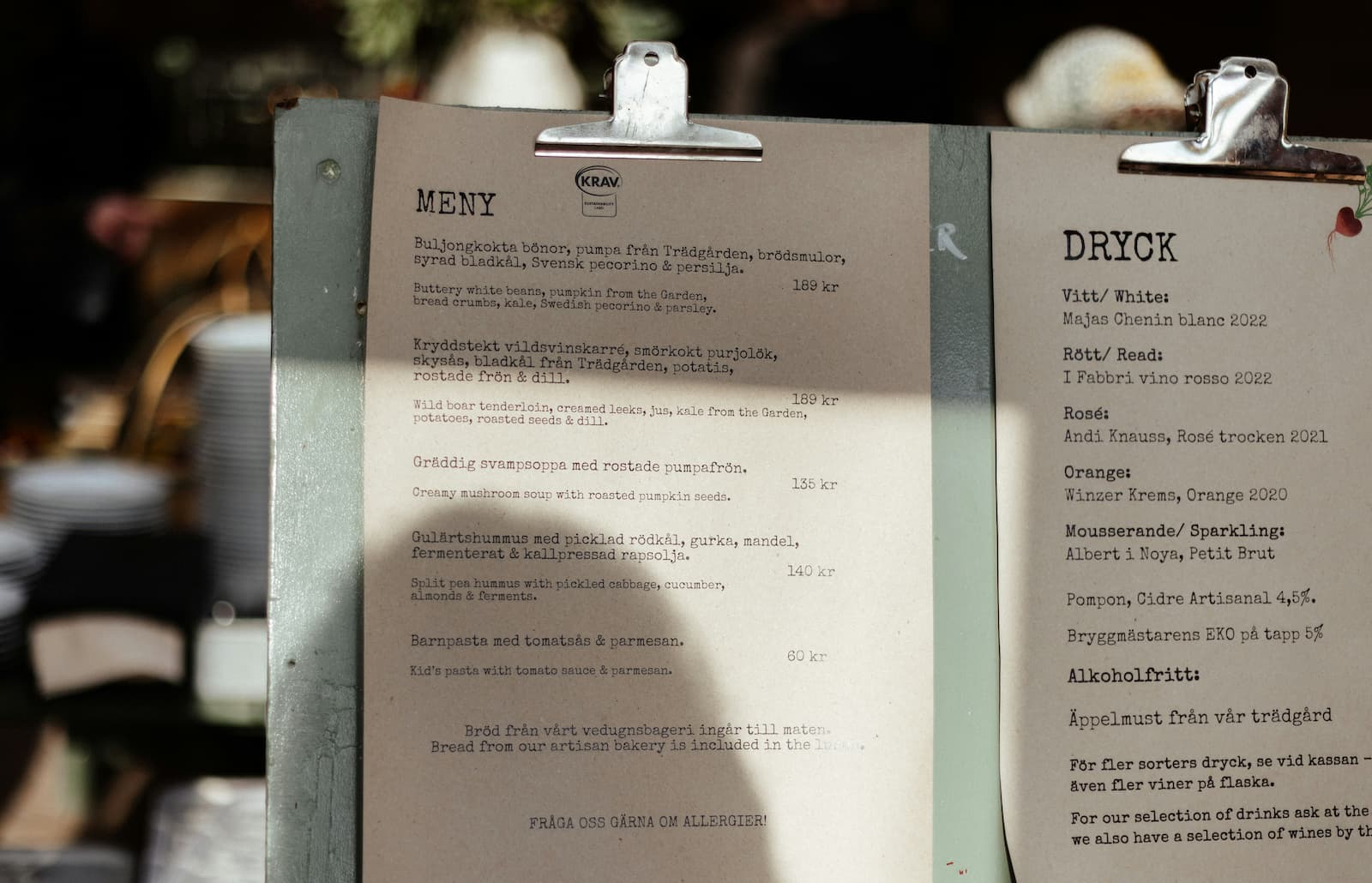
Pricing restaurant menu items is not just about choosing a number that “feels right.”
A good menu price needs to work for the business and make sense to the customer. It should protect margin, match the type of business, support the item’s role, and feel fair compared with the rest of the menu.
Many owners start with one question:
“How much should I charge for this dish?”
A better question is:
“Does this price make sense for the dish, the customer, the category, and the full menu?”
That difference matters.
A dish can be profitable on paper but feel too expensive to customers. Another can sell well but quietly hurt margin. A premium item can be correctly priced but poorly positioned. A cheap item can become too attractive and pull customers away from better-margin choices.
Good menu pricing is not guesswork. It is a structured decision.
Quick answer
To price a restaurant menu item, calculate the dish cost, divide it by your target food cost percentage, then review the result against customer expectations, competitor context, perceived value, and the item’s role inside the menu.
A simple formula is:
Menu price = dish cost ÷ target food cost percentage
For example, if a dish costs $4.50 to make and your target food cost is 30%, the starting price is:
$4.50 ÷ 0.30 = $15.00
This gives you a useful starting point.
But it is not the final answer.
A formula does not know whether the item feels premium, whether the customer understands its value, whether nearby prices are too close together, or whether the item plays an important role in the menu.
That is why pricing should include two steps:
- Calculate the price.
- Check whether the price works inside the full menu.
1. Calculate the real dish cost
The first step is to understand what the item actually costs to make.
Dish cost is the cost of the ingredients used in one portion of a menu item.
For example, a chicken sandwich may include:
- bread,
- chicken,
- cheese,
- sauce,
- lettuce,
- tomato,
- fries,
- garnish,
- packaging,
- and waste allowance.
A common mistake is to calculate only the obvious ingredients and ignore small components.
But small costs add up.
Sauces, oils, spices, garnishes, sides, packaging, and waste can quietly reduce margin. This matters especially for cafés, bakeries, delivery menus, cocktails, burgers, bowls, brunch items, and dishes with many small ingredients.
The key question is:
“How much does this item cost us every time we sell it?”
Not just:
“What are the main ingredients worth?”
2. Choose a target food cost percentage
Food cost percentage is the percentage of the menu price that goes toward ingredients.
The formula is:
Food cost percentage = dish cost ÷ menu price
For example, if a dish costs $4.50 to make and sells for $15.00:
$4.50 ÷ $15.00 = 30%
That means 30% of the selling price goes to food cost.
Many restaurants use food cost percentage as a pricing starting point. But the right target depends on the type of business, the item category, the service model, and the role of the item.
A café, bar, bakery, burger shop, full-service restaurant, and food truck may all need different targets.
Even inside the same menu, not every item needs the same food cost percentage.
For example:
- A drink may have a strong margin.
- A steak may have a higher food cost but support premium positioning.
- A dessert may be profitable only if customers actually order it.
- A breakfast item may need to stay accessible.
- A signature dish may justify a different margin because it brings people in.
Food cost percentage is useful, but it should not be the only pricing rule.
3. Use the pricing formula as a starting point
The basic restaurant menu pricing formula is:
Menu price = dish cost ÷ target food cost percentage
Example:
If your dish cost is $5.25 and your target food cost is 30%:
$5.25 ÷ 0.30 = $17.50
So the starting menu price is $17.50.
Another example:
If your dish cost is $3.00 and your target food cost is 25%:
$3.00 ÷ 0.25 = $12.00
So the starting menu price is $12.00.
The formula helps avoid random pricing. It gives you a rational base and makes cost pressure visible.
But the formula does not answer:
- Will customers accept this price?
- Does the item feel expensive compared with nearby items?
- Is the description strong enough to support the price?
- Is the price too close to cheaper alternatives?
- Is the item popular enough to support a lower margin?
- Is the item premium enough to support a higher price?
The formula helps you calculate.
Menu analysis helps you decide.
4. Compare the price with customer expectations
Customers do not know your ingredient cost. They judge the price based on expectation.
A customer may accept $18 for one burger and reject $18 for another depending on the business, portion, description, location, and alternatives.
Customer expectations are shaped by:
- the type of restaurant,
- the neighborhood,
- the design of the menu,
- the style of service,
- ingredient quality,
- online reviews,
- competitor prices,
- and the customer’s spending mood.
This is why the same price can feel normal in one business and expensive in another.
A $14 sandwich may feel reasonable in a premium café, hotel, airport location, or central brunch spot. The same sandwich may feel expensive in a basic neighborhood bar if the customer does not see enough value.
When pricing an item, ask:
- What does the customer expect to pay for this category?
- Does this price match our positioning?
- Does the menu explain why the item costs this much?
- Would the price feel fair before the customer tastes the dish?
The last question is important.
Customers decide whether to order before they experience the food. The menu has to support the price first.
5. Check competitor context without copying competitors
Competitor pricing matters, but it should not control your menu.
A competitor may have different supplier costs, rent, staff costs, portion sizes, quality, customer base, service style, and margin goals.
Copying their prices can create problems.
But ignoring competitors is also risky.
Customers usually have a rough idea of what similar items cost. They may not compare every dish exactly, but they notice when a price feels outside the expected range.
Use competitor context to ask:
- Are we clearly cheaper, similar, or more premium?
- Do we give customers a reason to accept our price?
- Are we underpricing items just because others do?
- Are we charging more without communicating more value?
- Do our categories fit the market?
The goal is not to match competitors.
The goal is to price intentionally.
6. Evaluate perceived value
Perceived value is what the customer believes they are getting for the price.
It is not only about quantity. It is about the full impression of the item.
Perceived value can come from:
- ingredient quality,
- portion size,
- freshness,
- uniqueness,
- preparation method,
- origin,
- house-made elements,
- presentation,
- brand trust,
- and the overall experience.
For example:
Chicken Pasta — $19
This may feel expensive.
But this version may feel more justified:
Handmade Tagliatelle, Roasted Chicken, Parmesan Cream, Fresh Herbs — $19
The dish may be similar, but the value is easier to understand.
This does not mean every menu item needs a long description. But higher-priced items, premium items, signature dishes, and items with strong margin potential usually need more support.
A price is easier to accept when the customer can quickly understand why it exists.
7. Look at the item inside its menu section
Customers compare items inside sections.
They compare pasta with pasta, burgers with burgers, cocktails with cocktails, coffees with pastries, mains with mains, and wines with other wines.
That means a price can be correct in isolation but confusing inside a section.
Example:
- Classic Burger — $13
- Cheeseburger — $14
- House Burger — $15
- Premium Beef Burger — $24
The premium burger may be worth $24, but the price jump is large. The menu needs to explain the difference clearly.
Another example:
- Chicken Sandwich — $12.50
- Pulled Pork Sandwich — $13.00
- Beef Sandwich — $13.50
- Vegetarian Sandwich — $13.00
These prices are very close. That may look simple, but it can make the section feel flat. Customers may not understand which items are basic, standard, premium, or best value.
Each menu section should make sense as a decision environment.
Ask:
- Are prices too close together?
- Are gaps too large?
- Is there a clear premium option?
- Is the cheapest item too attractive?
- Are high-margin items easy to notice?
- Do similar items have logical price differences?
Customers do not experience prices one by one. They experience them in groups.
8. Understand the role of each item
Not every item has the same job.
Some items bring customers in. Some protect margin. Some create premium perception. Some complete the menu. Some are popular but not very profitable. Some are profitable but hidden.
Common menu item roles include:
- Traffic driver: brings customers in or feels like strong value.
- Profit builder: has strong margin and should be visible.
- Signature item: represents the brand.
- Premium anchor: makes other items feel more accessible.
- Safe choice: gives cautious customers something familiar.
- Add-on item: increases average spend.
- Problem item: sells poorly, has weak margin, or confuses customers.
A dish with a strategic role may not follow the same pricing logic as every other item.
The question is not only:
“What should this item cost?”
The question is:
“What is this item supposed to do for the menu?”
9. Avoid blind price increases
When costs rise, it is tempting to increase every menu item by the same amount.
For example:
- Add $1 to every item.
- Increase all prices by 10%.
- Round everything up.
- Change prices only when printing a new menu.
This can create problems.
Some items may already have healthy margins. Some may be very price-sensitive. Some may be underpriced. Some may need better descriptions, not just a new price. Some may be too cheap and too popular. Others may be expensive but poorly supported.
A better approach is to review items by category and role.
Ask:
- Which items are most affected by ingredient cost increases?
- Which items are already weak on margin?
- Which items can absorb a price increase?
- Which items are customer-sensitive?
- Which premium items need stronger support before increasing price?
- Which prices should stay stable because they act as value signals?
Selective pricing is usually stronger than blind pricing.
10. Review prices regularly
Menu pricing is not a one-time task.
Supplier prices change. Customer behavior changes. Competitors change. Inflation changes. Popular items change. Seasonal products change. Delivery costs change.
Restaurants should review menu prices regularly, especially when:
- supplier costs increase,
- ingredient prices become volatile,
- the menu changes seasonally,
- a new menu is printed,
- bestsellers become less profitable,
- competitors shift prices,
- delivery platforms affect margins,
- or customers start trading down.
A quarterly review can work for many businesses. More frequent reviews may be needed for volatile ingredients such as meat, seafood, dairy, coffee, chocolate, oils, or fresh produce.
The goal is not to constantly change prices.
The goal is to avoid discovering margin problems too late.
Menu pricing checklist
Before finalizing a menu item price, ask:
- Do we know the real dish cost?
- Did we include small ingredients, sides, garnish, packaging, and waste?
- What food cost percentage are we targeting?
- Does the formula-based price make sense?
- Does the price match customer expectations?
- Does the item feel fairly priced compared with nearby options?
- Is the description strong enough to support the price?
- Does the item have a clear role inside the menu?
- Is the price aligned with our positioning?
- Would customers understand why this item costs what it costs?
- Does the price protect margin without damaging perceived value?
If the answer is unclear, the item needs more review before the price is final.
How MenuLab helps
MenuLab helps hospitality businesses analyze their menu before making pricing changes.
Instead of looking only at individual prices, MenuLab helps review the full menu context:
- pricing structure,
- item visibility,
- potential underpricing,
- price gaps,
- menu sections,
- margin pressure,
- item positioning,
- and which prices may need attention first.
The goal is not to change every price.
The goal is to understand where the menu needs action.
Some items may need a price increase. Some may need better wording. Some may need stronger positioning. Some may need to be reviewed because ingredient costs changed. Some may be fine exactly where they are.
Before changing prices manually, analyze your current menu to see which items actually need attention first.
Final thought
Pricing restaurant menu items is not about guessing, copying competitors, or applying one formula to every dish.
The formula matters. Food cost matters. Margin matters.
But the final price also depends on customer expectations, perceived value, competitor context, menu structure, and the role each item plays.
A strong menu price should answer two questions:
Does this price protect the business?
And:
Does this price make sense to the customer?
When both answers are yes, pricing becomes much stronger.